Saturday, 26 March 2011

Teaching at 11,000 feet


Fiona goes back to school

After almost missing the bus a second time, we had a journey of 3 bad films, chicken and rice and one game of bingo. After seven hours we arrived at Huancayo where James and I would be spending the next two weeks at a school. Huancayo stands at almost 3,300m (11,000 feet). It is not a rich place and most of the buildings are ugly concrete boxes. The city is surrounded by mountains and almost at any point in the city you can see the green hills, to remind you that there is something beyond the concrete.

We were met at the bus station by Mari, the wife of the school’s owner Tino. Mari got us safely into a taxi and we hadn’t driven 10 yards before a policeman stopped the taxi and discovered he had no license. We then had to get out and find another taxi (no idea if he had a license or not) to take us to our house. Tino is the man who started the mountain school. He is a world-renowned weaver (his weavings look like photographs they are so accurate) who has spent time in the US and Europe. However, he decided to invest his fortune and time into building the mountain school for under privileged children in Huancayo. The children who live in the hills in Huancayo are very poor, many of them suffer abuse, some have fathers in prison or parents who are alcoholics, some are orphans, and the majority of them work in the farms. Tino decided to open the school for these children, who would otherwise have no chance of an education. He is such a kind and caring man and it was a privilege to live with him and his family, even for such a short time.

There were four other volunteers at the school when we arrived; Emil and Ylva from Iceland, Lauren from Canada, and Amy from the US. They showed us the supermarket in town (which is like a Tesco Extra! No joke) and told us roughly how the school works. The next morning, Amy was sick and so James and I were sent to cover her lessons at a different school in a nearby town. Off we went in a taxi, not really knowing what to expect, or what to do!

The school was on a square and consisted of a couple of empty halls. The room we were directed to was a mezzanine directly above a conference that was going on, there was lots of music from below, not a great learning environment. The room had some chairs against the walls and a small table. There was not even a blackboard. What were we going to do? Very soon, the kids turned up. They were well dressed and quiet, carrying books and pens. There were only four of them and we soon learnt that their names were Nikolas (11), Karioska (11), Paola (9) and another little girl whose name I couldn’t catch (8). They showed us their books so we could get an idea of what they had been studying. We then improvised an hour and a half lesson with only some paper and a pen. It was so much fun!

Firstly we played bingo. James made the bingo cards and we had a shiny one pound coin as the prize. It was very sought after! Unfortunately, all four children shouted bingo at the same time. There is obviously a technique to making bingo cards (that James doesn’t have). We then learnt parts of the body and sang “Heads, Shoulders, Knees and Toes”, we looked at a picture of the world (according to James, should I be worried that as a pilot, his world looks quite different from the real thing?), and also played a game of bingo in which only one person won. It had been an exhausting introduction to teaching.

That afternoon we headed to the mountain school for lessons. A small bus named Petra took us up the hill. The bus is the perfect size for small Peruvians but James and Emil were like giants, and people stared at them as though they were aliens. The further you go from town and the higher into the hills, the poorer the communities are, and the worse the roads become. Off the bus, we jumped a stream (which we would be jumping every day) and headed up a dirt track to the school.
Dirt track to the school

Walking up the dirt track, you see little children emerging from everywhere, they squeeze out of doors, appear round corners, and race toward the track screaming “Teach, teach! Miss, miss! They then race up to you, reach up their arms and put their dirty little faces up to yours and give you a kiss. This is normally accompanied by “Good afternoon Miss” (always Miss for girls and Teach for boys). It is the sweetest welcome I think I have ever had, and I loved it every morning and afternoon.

Heidi and Jose-Luis on their way to school (with a pig!)

At class that afternoon, I shared a class of kindergarten children with Lauren. They were between 2 and 5 years old, and were adorable and terrible at the same time. After my first day teaching, I was both excited and nervous about going it alone the next day. I was going to have the kindergarten class in the morning.

Finding our feet at school

When we arrived and had been kissed by about thirty grubby faces we went to our individual classes. I stood at the front of class and was faced with six expectant little children, all fidgeting and rocking on their chairs. It was daunting, but after only a few minutes I was really enjoying myself. It was so sweet and rewarding to have the kids shouting English out at me, and they were each really pleased with themselves when they got something right. Towards the end of class they would become restless, and so I learnt that for the second class in the morning I had to teach something particularly fun to keep their attention. After a few days, James joined me for my morning class, and I had afternoon class alone. Our schedule went something like this:

8am Breakfast with the volunteers
8.30am Lesson preparations including trip to the photocopy shop
9.10am Take the Petra bus to school and get lots of kisses
9.30-11am Morning lesson with various Kindergarten children. Colours, numbers, animals, songs, games and the hungry caterpillar book
11am Play with the kids, get lots of goodbye kisses and take the Petra bus home
1pm Huge lunch with the volunteers followed by free time and lesson planning
3.10pm Take the Petra bus to school and get lots of kisses
3.30-5pm Afternoon lessons with my regular class of Yeni (6), Fredi (10), Nando (10), Alison (6), Edelinda (6), Dafne (10) and Diana (7). Colours, numbers, days, months, songs, word searches, snakes and ladders.
5pm Play with the kids, get lots of goodbye kisses and take the Petra bus home
5.30pm James and I have a Spanish lesson with Tino’s neice
7pm Dinner with the volunteers and freetime

We became really used to our schedule, and although we were only actually teaching for a few hours each day, it was exhausting. Keeping a bunch of very young children entertained for the duration of class was very tiring and took a lot of energy, but it was so rewarding. I began to really look forward to classes and seeing those expectant little faces, and the children racing towards you for a kiss and class.

The Top 5

I know you are not supposed to have favourites as a teacher, but I just couldn’t help myself. As in my last teaching position, the criteria for being my favourite are threefold: male, mischievous and cute. Although one little princess did win me over and she was neither male nor mischievous. So here’s my top five:

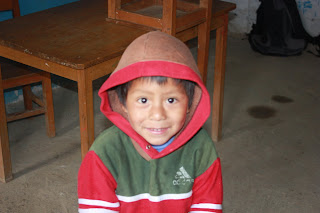
Number five - Jose-Luis
This little four year old in my morning class was never without a smile (although sadly he had very bad decay in his teeth and clearly never brushed them). He was normally able to stay focused for about the first twenty minutes of class, before his mind and body would start wandering. He was often one of the first to race over to you on the walk up the track to school and he liked to hold your hand on the way to and from school.

Number four – Rubinho
Rubinho was a very clever little boy who was sometimes too shy to raise his voice and show how clever he was. Supposedly he had been in class with his older sister for a long time and had only just gone it alone when she moved to an older class, this meant that he was left to fend for himself. He was happier working on his own and whispering answers to questions in your ear, rather than in front of the whole class.


Number three – Edelinda
Edelinda (pronounced Yedalinda) was the cutest little girl in my afternoon class, she always wore a little sunhat and layers of clothes, despite the heat. She was studious, and despite being only 6 years old, she was able to copy down words and would take exercises home to complete. She was very shy and I would have to get very close to her to hear her answer a question, and if she needed help she would look at me with pleading eyes rather than shout like the others. Towards the end of school she would always come up to me and say that she had to leave at 5pm, and could I please tell her when it was 5pm, she would then come up to me repeatedly and ask “Is it 5 yet?” I have no idea why she had to be so prompt in leaving. She was a conscientious little angel.

Angel in pink

Number two – Nando
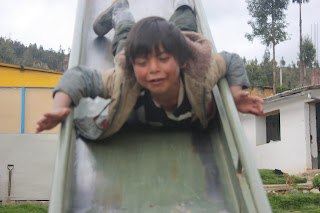
Nando was a real character from my afternoon class. He was 10 years old but the size of a boy half his age, and he worked the fields with his family when he wasn’t at school. At weekends I sometimes saw him herding cattle and he wore the same clothes to school as he wore in the fields; wellington boots, tatty corduroy trousers with a broken fly (which he was constantly trying to do up), a dirty woolen jumper and a coat. (Just to note, it wasn’t just Nando, most of the kids wore the same clothes to school day after day). One day we were able to give all the children presents (courtesy of a past volunteer from the US) and I decided to give Nando a pair of shorts and a toy, he seemed very happy, and like all the other children he turned up in his new outfit the next day. Nando was intelligent and fiercely competitive, he never won a game of snakes and ladders (the kids favourite) but he put a lot of effort into every throw of the dice and it killed him to lose.

Nando enjoying breaktime

Number one – Angelo
Angelo was a tiny boy in my kindergarten class. He was no angel, but he was very intelligent, energetic, and competitive. Normally, as soon as I pulled out the flash cards at the beginning of class (they had colours and shapes on them), there would be a group chant of “No! no miss!” However I soon came up with a game with the flashcards which had the kids jumping off their seats and Angelo was particulary enthusiastic. I would hold up the card, for instance ‘yellow’, and the first kid to shout out the right word would get given the card, to build up a collection. Such a simple game, but the little ones were so competitive that they would be leaping out of there chairs shouting colours and shapes at the top of their voice. And Angelo was the best, his little eyes would shine as he shouted at the top of his voice, and he always won. I also loved the way he would check with us for everything, he would never commit a crayon to paper without checking with us that it was the right colour.
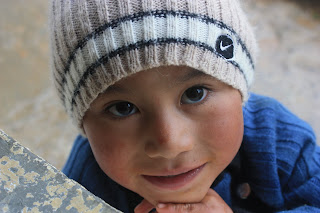
Like butter wouldn't melt in his mouth

Summary
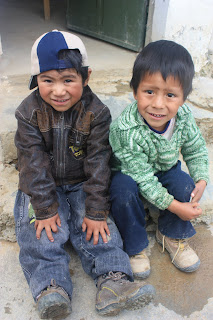
When it came to my last day at the school I tried to pay particular attention to all the kids, how happy they were; how tangled their hair was, how nicely they played together. I wanted to remember them all, because they were such great kids. After play time, it was time for us to go, I shouted goodbye to them and like every day they would run and kiss you goodbye saying “Bye miss!” into your ear. I tried not to, but I couldn’t help myself and I cried. The likelihood is that I will never see them again and the likelihood is also that they will continue to live in poverty. A few lucky ones may make it down the mountain (and up the social class), but most will work in the fields, like their parents, they will have too many children for too small a house, and their own children will grow up in torn clothes, with decaying teeth, and fleas. I think that is what made me feel so sad on that last day. But one thing I am sure of, however poor the children at the mountain school are, and however poor their own children are destined to be, they will always have a smile on their faces and kindness in their hearts.

Thank you so much to Tino and his family (Mari, Leslie, Angela and Pilar) for an amazing stay in Huancayo, and thank you to the children at the mountain school who taught me more then I could ever have taught them.

Extra memories

Take a look at this amusing video of Zafira eating God knows what and following the "three second rule". Also a few other photos

Zafira and the three second rule


Angelo and Jose-Luis - little hustlers
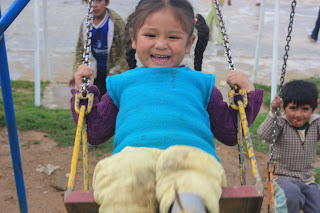
Heidi on the swings

Friday, 25 March 2011

Lima Longer

From Buenos Aires I travelled to Lima, Peru to meet up with my friend James. We would be spending a few weeks teaching youngsters in the highlands, but beforehand we had two nights in the capital. We visited the city centre and wandered from square to square (something to do with us not knowing where on earth we were), I ate ceviche (Peruvian specialty of raw fish in lemon), we bought bus tickets for our trip into the highlands, and we saw some art that made us giggle. The centre of Lima is nothing to write home about, and so I won't.
One of the many squares of Lima with a fountain. They all look pretty much the same, with variations on the placement of the fountain and palm trees.

That evening we drank the compulsory pisco sours of Peru and tried to find a restaurant that served vegetarian food for James. We were hounded into a restaurant with the promise of plenty of vegetarian options. However, they had basically nothing on the menu that was vegetarian (didn't seem to understand that vegetarians don't eat meat or fish) and James ended up with some very bland pasta. I have my suspicions that the reason it took so long was because our waiter was picking the meat out.

On the day of our bus into the highlands, we took it easy with a late breakfast, and time on the internet. We then took a taxi to the bus terminal. Shortly before we were about to board the bus, I told James that we might need our passports as ID for the bus. At that point, James turned a very pale shade of pale and started rooting through his bag. Not only had he left his passport at the hostel, he had also left a few other important things like all of his bank cards, his international driving license, all of his US dollars, camera, all his flight tickets, vaccination records, staff ID card, watch, USB drive with copies of all his important documents, and travel insurance documents.
A few things James decided he didn't need to take with him!

For this reason we missed our bus to Huancayo and James swore a lot. However, as James dashed back to the hotel in an attempt to get back his belongings, he met a taxi driver full of character, who tried to get him to shout at girls out of the window, and who taught him some filthy Spanish phrases. I ate a nice packet of crisps. So we both got something out of the missed bus. With an extra afternoon and night in Lima we headed to a Miraflores and checked into a very kitsch "Hotel Eiffel".
James had already looked stupid that morning, this was his second chance!

Miraflores is a beautiful part of Lima with nice parks, cats, market stalls and also great views over the sea. We wandered around and did what everyone else in Miraflores seems to do at sunset, headed down to the viewpoint to watch the changing sky. It was lovely and relaxing wandering around the area that overlooks the sea, it has a raunchy sculpture and mosaic walls and seats remniscent of Barcelona. Everyone there seemed to be in high spirits. Even James had finished cursing himself by this point, and we were both glad that his forgetfulness had bought us an extra day in Lima. Thanks James:)

James feeling pensive...

Here's Jimmy!
View from Miraflores

The next day (like Groundhog day), it was time to do it all again, and maybe this time we would get out of Lima...

Saturday, 19 March 2011

La Paz and Lake Titkaka

Christian writes (yes, he is able):
I hugged Fiona goodbye and made my journey by plane to La Paz. I was expecting warmer weather for some reason but being Bolivian winter (no idea), it was colder here and to add to that the altitude winded me like a fist to the chest - I had to walk very slowly from the plane and tell myself I was not going to keel over!

After a nap, some dinner, a visit to the night market (three ties for £8!) and a good night's sleep, I went exploring the city properly. It reminded me that in South America so far we've been in two fairly prosperous countries; many people in Bolivia are scraping a living together offering whatever services or goods they can. Highlights were men on the street with typewriters (we write your letter while-u-wait), we-laminate-what-you-want and women making and selling jelly and ice cream. At the same time, La Paz has a sort of tourist ghetto, so sometimes it felt a little awkward and a bit contrived.


The following day I took a bus to Copacabana, the main town on Lake Titikaka. The town itself is really nothing to write home about, with another tourist ghetto strip. However, the lake itself and the mountains surrounding it were truly beautiful. I took a boat to see some floating reed islands (although when I got there I was told they were made for tourists) and took a breathtaking walk back to town along the lake. Parts of the trail were made by the Incas, and there were lots of locals to say ¡Hola! to, or who tried to sell me bits of tat or a rowing boat trip or a taxi journey or their faces in a photo (yes because I am tight (maybe Fiona's influence!), I deprived a family of Bolivians their photo fee for the image below).


Now, many have asked me along the way of this trip, "have you found yourself?" or "has the experience changed you?" or "do you feel closer to the spiritual energy of the earth?". Well little did I know that the Isla Del Sol, in the middle of Lake Titikaka was going to help me answer these questions. To get to the island, you have to take what can only be described as a death trap (three people to a two-person seat, no life jackets in site) with many an unwashed Argentine hippy. The island itself has some interesting Inca and pre-Inca ruins and some charming little towns run by highly authentic Bolivian ladies.


That evening, I had booked a night at an Estancia. For those who don't know, this is a farm stay type affair, with home-cooked group meals and is typically an authentic experience. I arrived in time for dinner to meet three ladies. Two Argentine homeopathic and spiritual-psychological healers. And one Australian lady who had spent the last eight years finding herself, by means of travelling the world, listening to her guru, banishing all pills, singing at ancient ruins and you can imagine the rest. And so it was that I found myself in the company of these wise and potentially life-changing ladies for several hours whilst being served under-salted overcooked food without any wine. I can honestly say this is the closest I have been to a life-changing experience. But then that's probably because I've never been anywhere near one before. Let's say I was in bed by 9.30pm. In South America!

Bolivia is a truly beautiful country, with some of the most stunning scenery on the trip and it did feel like raw South America. I only spent a few days there and I knew there was much more to see. Though I couldn't help feeling the tourists and locals were a bit misaligned. The country seemed to attract a born-traveller type that I was surprised to feel didn't really fit in with the locals.


Leaving the country I got a fairly long grilling as to why I was travelling alone, having visited the coca-loving country for just a few days, going to Brazil as a non-Brazilian national. You'll be pleased to know my English charm spared me from 'secondary screening.'

Christian and Fiona

Location:La Paz, Bolivia

Monday, 14 March 2011

Fakes, poetry and cockroaches


On dad’s penultimate day in Buenos Aires I took him to one of my favourite places, San Telmo market on a Sunday. San Telmo is an old part of town with cobbled streets which remain fairly quiet most of the time. However, on a Sunday the place comes alive. The streets are closed to traffic and a huge market extends about fifteen blocks along Defensa street. It is made up of artesans selling jewellery, paintings and crafts, and also antique dealers selling everything that is old. It is a great place to spend a few hours pottering, unless you are my dad, whose least favourite pastime is shopping. We decided quite quickly that he would leave me some cash and I would buy the presents he needed to buy (perfect situation for me since I get to shop with someone elses money!). After a quick visit to a cashpoint, I spent a happy afternoon wandering the scorching cobbles of San Telmo buying gifts, whilst dad went home to enjoy some air condicioning.


Poetry in a taxi

After shopping in the heat I was exhausted and found a taxi to drive me home, and what a character I met in the taxi! My taxista was 73 years old and had lived in Buenos Aires all his life. He told me all about the good old days in Buenos Aires and how he should not be working at his age, he moaned about Christina Fernandez and her government, and told me the only riches in Argentina these days are in nature. I tried to keep up with what he was saying and ask appropriate questions and we managed to chat (well, him mostly) all the way home. When we pulled up outside the apartment he stopped the car and turned to face me. He told me he was not just a taxista, he was also a poet. He asked my name and when I told him, he made up a poem off the top of his head, each sentence beginning with the letter of my name, F, I, O, N, and A. It was very complimentary about a girl he met in his taxi. I thought he had finished and I gave him a round of applause and showed my gratitude. He then asked for my surname! And again he continued the poem with each line beginning with the letters M, C, C, R, E, A, D, Y. It was somewhere around the line beginning with R that his eyes welled up with tears and he began to cry. It was very touching and it almost had me crying along with him. I don't know what moved him to tears but he squeezed my hand very hard when we parted.


Coackroaches

That night we celebrated dads last meal in Buenos Aires by going out for steak. Christian and dad sat opposite Emily and myself. We had a good meal and bad service (I am now used to this). During the meal I saw something crawling up the wall behind a table at the other end of the restaurant, it was the size of a mouse and it took me a while to realize it was a cockroach. By the time I realized this, the creature had fallen down from the wall (presumably the weight of it's massive body had become too much for it), and no-one seemed to believe me. I soon forgot about it. Towards the end of the meal, Emily let out a loud scream, grabbed my arm and pointed at Christian, just above his head on the wall was a huge cockroach. I also screamed and we both stood up scraping our chairs along the floor. Everone looked at us, assuming something must be really wrong, but when they saw the cockroach on the wall, everyone continued eating as though it was normal! Luckily a waiter took action (eventually, probably because the noises Emily and I were making were putting people off their food). He knocked the cockroach to the floor and stood on it.

Fakes

We decided that we should probably go somewhere else for dessert and after we had paid up we went outside to get our bearings and decide where to go. On our way out of the restaurant an older lady pretended to jump at Emily like a cockroach, her and her husband then laughed their hearts out. It was pretty funny I have to admit. Once we were outside, out waitress ran after us. We had paid her with fake money! She passed back the fake notes, and we realized that it was the money dad had withdrawn from the bank machine at San Telmo. She gave us all a valuable lesson in how to spot a fake 100 peso note (which I actually learnt last time I was here) and we went to a cash point to get her some real money.

It had been an interesting day, and I think the pieces of it are quite representative of Buenos Aires as a city, there is the romantic side of Buenos Aires (taxi poetry) which is countered with a seedy side (fake money), and however nice the people are, there are some cockroaches around. Fortunately, the cockroaches and seediness are invisible most of the time, we were just unfortunate (or fortunate?) to experience the full range on dads last day.


Sunday, 13 March 2011

Back in BA

Second Impressions

It had been two years since I had set foot in Buenos Aires and I was apprehensive about how I would feel about the place.  The last time I had loved the city, and it had demoted Rome to second place in my favourite cities list.  Would I like it as much this time around?

On our flight to Ezeiza International Airport, we were told 20 minutes before landing that we would instead be landing at the Buenos Aires Domestic Airport, because the international airport was too busy.  This was great news for Christian and I, as we were renting an apartment in Palermo, which was not far from the domestic airport.  For other passengers however, this was far from good news, as they had international connections to catch.  The baggage reclaim area was even more hectic than we had become used to, with passengers desperate to get their luggage in order to rush over to the international airport (at least an hour away). 

We had been warned that the taxistas would try and scam us on our arrival, and I said to Christian “we’ll be OK, look, we have a lady driver” as our taxi pulled up.  What was I thinking, that female loyalties would protect us?  She drove off before she would tell us the price and hugely overcharged us despite our objections.  Not a good start to our time in BA.

However, things soon picked up when we arrived at our apartment.  Booked through an Argentine agency (http://www.bairesapartments.com/) we were staying in a two bedroom apartment in Palermo Hollywood (where the film and TV studios are based).  Sergio, the owner of the apartment was charming and showed us around the apartment and communal areas.  It was fantastic!

IMG_8162

Can anyone spot a glass of red wine in this picture… and also the fact that the shot is a little out of focus?  The two are connected.

IMG_8163

There was even a handy pair of shoes hanging outside, to help us locate where we lived

On our first day in Buenos Aires, Christian hit the sun terrace whilst I wandered around Palermo.  It was just as I remembered.  Cafes, boutiques, outdoor dining, and tree-lined avenues.  The district of Palermo is perfect for strolling, enjoying a coffee, and people watching.  And the people of Buenos Aires are quite nice to watch!

That night we met up with dad (who was staying a night in another fancy hotel) and Emily for dinner at La Cabrera, one of the best steakhouses in the capital.  The meat was magical and the portions huge.  The next day dad moved into the apartment and was amazed at the high standards I had managed to attain.  I think he was worried I would have him staying in a shack (much like our Cuban experience, sorry again dad!).  He spent a while “wowing” at all the fixtures and fittings, and then we headed out to the parks of Palermo.  The botanical garden is beautiful and full of cats, which makes for my perfect park.  Following our first visit, dad and I returned with some cat food and made a good friend out of a scrawny tabby cat.  (at the end of our stay we forgot to take the remaining cat food out of the fridge, so I am wondering whether Sergio the landlord now thinks we eat cat food!)

IMG_8173

Clearly signposts do not apply to cats

IMG_8175

A statue in the botanical gardens

Very close to the Botanical garden lies the Evita museum, which is housed in a shelter house that Eva set up for people without homes.  It is a lovely building and for my dad and I, who are both fans of Eva Peron, it was a fantastic place to spend an hour or two.  The exhibition charts her life from childhood, through her hedonistic years on radio and film (you can hear her singing and watch clips from her films), to meeting Peron, all the changes the couple bought about for Argentines, the clothes she wore, and finally her death.  You can hear her final shaky speech to the people of Argentina and the footage of her funeral procession is mesmerizing and very moving.  A fascinating museum (with a good cafe).

IMG_8177

The Japanese gardens… a good place if you like trickling water and big fish

After a stroll around the Japanese Gardens, we said goodbye to Emily, who had a flight to New York to catch, and had a home cooked meal for the first time in weeks. 

The Stylish Dead

The next day a taxi driver, who was happy we weren’t Americans, drove us to Recoleta cemetery.  The cemetery houses many of Argentine’s rich and famous dead, including of course Eva Peron.  The cemetery is more of a town than a cemetery, and the graves themselves are more like expensive homes. 

IMG_8193

Dead Street

IMG_8197

We found a fresh one! 

 IMG_8190

Eva Peron, buried in the Family Duarte vault

The cemetery makes for a peaceful stroll in the otherwise busy area of Recoleta, and like the parks, you are likely to meet a few friendly cats on your way.

We lunched in a design restaurant where both dad and Christian attempted to urinate in the sink, before they realized there was a urinal behind them.  We then took a look around the Fine Arts museum which had some fantastic sculptures, and wandered over to see the giant flower sculpture (Floralis Generica) that opens and shuts with the sun.

IMG_8214

Late that evening we discovered Emily had not in fact left Buenos Aires, she had sat on a plane for a few hours before the pilot decided there was too much snow to land in New York.  And so back she came, via a swanky hotel, paid for by the airline.

Casa Rosada

One day dad and I decided to go and visit Casa Rosada (the pink house).  This is the governmental building that stands in front of Plaza de Mayo.  If you are a fan of Evita, you will recall this as the building from which she makes her stirring speeches to the people of Argentina, the balcony from which Madonna sings “Don’t cry for me Argentina”.  Go on, take a look, you know you want to!


It is virtually impossible (for me and Christian anyway) to walk around Plaza de Mayo without singing Evita.  We tried to go inside the museum here but it was shut for the day, and when Christian and I visited a week later, it was still shut.  Note: you can’t trust guide books or official opening times in South America, if they fancy a holiday they will take one.

IMG_8264 Don’t cry for me Argentina, the truth is the museum’s never open

After failing to get inside the Case Rosada, we had a giant lunch in Plaza Dorrego, whilst a couple tango danced next to us.  Dad and I also went to the Carlos Gardel tango show one evening to witness some amazing tango and a noisy American (I thought dad might hit him!).

IMG_8230

IMG_8238

I think she is looking for her contact lens…

The rest of our days in Buenos Aires were spent relaxing by the pool, wandering around the boutiques and cafes of Palermo, and pondering where to go for dinner.  I love the days of your life when the biggest decision you have to make is where to go for dinner!  Our last sunday in Buenos Aires with dad deserves a whole blog to itself, since it was so full of incidents, make sure you read “Poems, fakes and cockroaches”.

Day across the water

One day, dad and I decided to take the ferry across to Uruguay.  Surprisingly (since this involves not one, but two South American countries), this is a very efficient and speedy process.  We arrived bright and early at the modern ferry station at Puerto Madryn, an hour before our ferry departed.  We had a good cup of tea that was served very efficiently and politely to us, I used a bathroom that had toilet paper in, and we boarded the ferry and set sail on time.  It was like being back in Europe!  The ferry over to Colonia takes 2 hours (if you want to go to the capital of Montevideo, it is 5 hours).  Colonia is the closest town in Uruguay to Buenos Aires and this is about it’s only claim to fame.

Stepping off the ferry in Colonia is like stepping back about fifty years.  The streets are cobbled, the cars are antiquated, and there is no-one around.  A dog befriended us very quickly and led us into the centre of town.  Colonia was a Portuguese colony and still has elements of Portugal about it, including some remnants of architecture.  It is probably one of the sleepiest towns I have ever visited, but it has a gentle charm about it, and would be a great place to relax, if you had the money!  It is surprisingly expensive here.  We stopped for an expensive coffee and cake, but after 45 minutes we went without cake (back to South American efficiency) and moved on to look at the port. 

After watching a yacht struggle to moor for a long time (these are the things you can do with time on your hands!) it started to rain, really rain!  And so we ran into the nearest restaurant.  It may have been ridiculously expensive, but it was a great find.  We were the only human guests and were given first-class attention from the staff.  The floor was topsy turvy tiles, the walls were covered with original paintings (that captivated dad) with hardly any space between, the windows were overflowing with plants, and there were seven dogs and a cat inside!  It was a very bohemian place to share a salmon lunch.

Once the rain had stopped and we had parted with too much money for lunch (these are the kinds of thing a Scotsman and his daughter remember), we took a slow walk around the coastline back to the ferry.  As on the way out, we both fell asleep on the journey home, which makes two hours go very quickly.  (once again, I am writing this in a cafe and Bonnie Tyler is singing!)  Back in Buenos Aires, it was time for dad to pack ready for his flight the next day. 

Lots of farewells in Buenos Aires

Buenos Aires marked the end of my time with Christian, I had to say goodbye to Emily, and it was also the end of my week with dad.  Lots of goodbyes.  Dad’s visit had been well timed, as it was exactly half way through my six month trip, it had been so good to see him, and to be reminded of his sense of humour, intolerability to heat, and generosity.  Thanks for all the treats dad!

IMG_8165 

Dad, it’s time to invest in a new panama!

It was also time to say a fond farewell to Christian, my travel buddy of three and a half months.  He was moving on to Bolivia for a week or so, and I was staying in Buenos Aires a few more days before heading to Peru.  Before we left England, I think we both had reservations about whether we would get along for such a long time together, and I can happily say that we got along famously, with no arguments or cross words.  Christian, I will miss you!

IMG_8101

What?  You mean I have to go to Bolivia and speak Spanish on my own?…

I spent a few extra days relaxing and meeting up with friends in Buenos Aires, before it was time to leave.  I still love Buenos Aires, for me it is a great mix of history, design, open space, romance, great wine, great food and cats.  I think the best thing about it is the crossing of two cultures, South America with Europe.  Something tells me I will be back… and so once again (all together!), don’t cry for me Argentina, the truth is I never left you.

Monday, 28 February 2011

To the ends of the earth

I adored the bus journey from Puerto Natales, Chile to Ushuaia, Argentina for many reasons.  Firstly, because there was a modern day gaucho on our first bus, attired in gaucho boots and gaucho hat with North Face accessories. Secondly, because this bus drove for two hours into a dusty wilderness where another bus was waiting for us, our bags were thrown from one hold to the other, we were thrown from one bus to another and off we went.  Thirdly, because this next bus was almost empty and we were able to stretch out and have our pick of seats.  Fourthly, because we stopped at a ramshackle estancia which inside, looked like something out of 50s America, and served fantastic cherry pie.  And fifthly (I will stop soon because you must be getting bored), the scenery was amazing.  I could have stared out of that window for much longer than 7 hours.  I had Karen Carpenter and Mick Jagger (quite a mix) singing to me as the scenery changed around me.  The views of Patagonia were remote and endless, but as we travelled further south, the landscape closed in on us, until for the last few hours we were bound on all sides by towering mountains.  It was stunning.

IMG_8064

Modern-day Gaucho sporting a North Face shell jacket

As an aside, I would encourage anyone travelling in Patagonia to move between places by bus.  The views, the feeling of isolation and the comprehension of distances are fantastic by road. 

Ushuaiua was not what I was expecting at all.  In my head (and for no real reason) I thought it was going to be dreary and grey.  Perhaps that is how I envisage the end of the world to be?  However, when we arrived the sun was shining and a pretty bay stretched out in front of us. We walked alongside the bay to get to our Bed and Breakfast, which was a homely place in which we had to take our shoes off before we went upstairs.

That evening we walked into town looking to eat the local specialty for dinner; King Crab.  We found a popular restaurant (Freddy’s) and Christian sat next to a tank of King Crabs whilst we both ate one of their brothers or sisters.

IMG_8075

Christian with a crustacean friend

The next day we walked up hill until we came to the ski lift and restaurant.  Although it was out of season the chair lift was still running and the restaurant served us a tasty lunch that we ate outside in the sun.  Rather than skiing, another activity was available, and we both opted to do zip-wiring through the trees.  It was fun being tarzan for an hour or so.  Afterwards we hiked up the rocky piste and kept climbing until we reached the glaciar.  Although the glaciar is very small (and seemingly insignificant) compared to the others we had seen (in New Zealand and Patagonia), the views of Ushuaia were terrific and we were able to walk onto the glaciar safely. 

Someone had carved a slide into the glaciar’s snow and while our can of Coke Zero was chilling in the ice, we took turns at sliding down it on our bottoms.  It was so much fun!  Probably the most fun I had had on a glaciar.  When we were well and truly wet through we sat on rocks looking out at the view and drinking our glaciar-chilled can of coke.  Bliss

Walking up and sliding down the glacier at Ushuaia

Slipping and sliding down the glaciar

Walking up and sliding down the glacier at Ushuaia

Wet bottoms but happy

Walking up and sliding down the glacier at Ushuaia

Walking down the mountain, dry bottoms!

We then took the chairlift down the mountain and strolled home, before enjoying a pizza and sushi dinner.  It had been our last full day in the deep south of Argentina and it had been so much fun.  I took a walk around the bay at sun down to get some photos, they will remind me of how much I liked Ushuaia. 

IMG_8114


IMG_8122

Reflecting on Ushuaia

The next day we had breakfast with the other guests at our B and B, and walked with our new friend Hadrien into town.  We found the ubiquitous sign that you HAVE to have your photo taken next to, and then we got soaked as the rain pelted down.  It was then time to get to the airport for our flight to Buenos Aires. 

I felt a little sad leaving Ushuaia, it marked the end of our journey in Patagonia.  It had been such an adventure and a place more remote than I had ever encountered before.  The landscapes are so immense that they make you feel tiny, and really help put things into perspective.  Patagonia had been my favourite part of the trip so far.

And so on we went, from empty Patagonia to populous Buenos Aires, where among other people I would be meeting dad again.  Adios Ushuaia, I hope one day to make it to the end of the world (fin del mundo) again.

The end of the world

I went to the end of the world with Christian

Torres del Paine in the rain

After a week of protests, the government appeased the Chilean protesters by lowering their proposed 17% rise in gas prices to a mere 3% rise.  The ports were re-opened, the roads unblocked, and people were able to move in and our of Chile once again.  Tourists who had been stuck in Puerto Natales moved out and made space for new tourists, like Christian and I.

From El Calafate we had an uneventful but long bus journey to Puerto Natales.  As soon as you cross the border between Argentina and Chile you notice the difference.  The people are considerably shorter than their Argentine counterparts, they look more native, and seem to be friendlier.  For Christian and I, much of Chile felt like the poorer neighbour to Argentina.  If South America was a street, Argentina is the white-washed house with perfectly preened roses whilst Chile is the scruffy student-house next door where they party all hours (in actual fact, depending on how you cut the figures, Chile is now richer than Argentina).  Of course, this is all relative, and the UK would live in a different area altogether!

Puerto Natales is a scruffy town next to a beautiful lake.  If it weren’t so wet when we arrived it would probably have had the feel of a dusty frontier town, but as it was, the roads were mud instead.  We stayed at Lili Patagonica hostel and were really impressed with the helpfulness of staff there. 

The only reason to stay in Puerto Natales is because it is the gateway to the Torres Del Paine national park, 70 km away, and we soon made arrangements to visit.  Our very original plan was to trek the famous “W” trail for three or four days.  However, when the gas price protests thwarted our plan we were only left with a day in the national park.  We booked a guide who would take us up to the most famous view of the Torres (towers in English) and we started off early the next day.  We drove to the National Park entrance, signed in with a man who gave us a ticket and pointed us to a man just next to him, stepped over to the next man and gave him our ticket, paid this man, and were then pointed to the original man again who gave us a leaflet. (Great use of resources once again, why use one man when you can use two).

IMG_8021

Christian filling his water bottle

We met our guide and fellow walkers (an older British couple Graham and Marion) at the base of the park.  We filled up our water bottles at the stream and started upwards.  The walk was varied and interesting in terms of views and surroundings but one thing remained constant… the darkening skies.  Rain jackets were needed pretty early on but by the time we were making the final ascent to the viewpoint the weather had subsided.  This is the only really tough part of the walk with a couple of scrambles over rocks, but generally it was pretty straight-forward.

IMG_8034

The highlight of the Torres del Paine national park are the three Torres themselves, but as we climbed higher and higher we realized that the weather was closing in, and that we weren’t going to get the view that we had climbed for.  In fact when we reached the top we only had a view of about 2/3 of the Torres, with the rest shrouded in cloud.  Very disappointing.

IMG_8038 Christian with the beginnings of the Torres behind him

IMG_8044

Disappointed and cold faces at the top

We cheered up a little on the way down, especially after we had eaten a gourmet lunch (great work from the guide!) and a rainbow had come out.

IMG_8048

Christian!  I said that we cheered up when the rainbow appeared, you still look miserable.

At the base of the climb, Christian and I had the worst hot chocolate of our lives in a fancy hotel, full of noisy Americans.  Our guide told us that Pinochet had granted one of his friends access to development in the National Park, and as a result a hotel had been built, the National Park are not happy about it, but there is nothing they can do.

The bus drive back to Puerto Natales gave us some amazing scenery as the sky brightened up, probably better than we had seen all day, and we also saw some ostriches and guanacos.

IMG_8058

Spot the ostrich

Back in Puerto Natales, we found the bus station and booked our next day’s journey to Ushuaia, and went for a delicious barbeque meal.  After a final night in Chile, we were heading to the ends of the Earth, and crossing over once again to Argentina.  It is worth noting that once upon a time all these border crossings were not necessary.  Patagonia used to belong to Chile, but when Chile was at war with Peru and Bolivia and the northern border of Chile was in jeapardy, they decided it would be pertinent to avoid any upset of their other borders, by ensuring peace with Argentina.  At this point they gave the Argentine’s a large piece of Patagonia, and so only a narrow slither of Patagonia remains as part of Chile.

And now down, down we go.  To the ends of the Earth!